Join 500+ digital marketers getting weekly AI visibility tools, tactics, and search updates. Free • 5-min read • No spam.
Visibility #15: Brand Authority Beats Topical Authority
Brand Authority Beats Topical AuthorityThe Visibility Report -- Tuesday, May 5, 2026 AI search is making an old marketing truth measurable again: visibility is not just what you publish. It is whether the market, the machine, and the citation graph already believe you are a credible answer. 🔥 Top Story: Brand Authority Is the AI Search MoatSearch Engine Land argued that brand authority now matters more than topical authority in AI search. The useful distinction: publishing more pages does not automatically make a brand cite-worthy. AI systems appear to reward demand, mentions, entity clarity, and third-party proof -- the signals that make a brand easy to recognize and trust. Why it matters: content volume alone is a weaker strategy when the answer engine is deciding who deserves to be named. Read the analysis 📊 AI Visibility ResearchFoundation + AirOps: The teams analyzed 57 million AI citations and found brands owned 10% of them. That is a useful benchmark for the hidden selection phase -- the moment before a buyer reaches your site, when AI systems decide which brands belong in the answer set. Read the citation study Writesonic: Their GPT-5.5 citation study found brand-site citations fell to 47%, down from 57% in GPT-5.4. The reported driver was a sharp drop in site: operator usage, which means citation behavior can change when the retrieval pattern changes. Read the data Semrush: Wise.com is showing up as a fintech AI visibility case study. Semrush points to brand strength, structured explainers, high-intent topic coverage, and credible third-party context as factors behind the visibility. Read the case study 🚀 Platform & Search ShiftsAI visibility starts before search: Search Engine Land made the case that influence, entity signals, and original data shape who gets cited before the query ever happens. That matches the broader move from rank tracking to citation tracking. Read the framework AEO tools are getting practical: A new Search Engine Land roundup covers seven tools teams can use now to understand and work on AI answer visibility. The category is moving from theory to operating system. See the tools Google's Preferred Sources went global: Google expanded Preferred Sources to all supported languages, giving users more control over the news sources they see. For publishers, this is another reminder that being chosen as a source can matter as much as ranking for a query. Read Google’s update 📝 From the Tool BlogsSemrush:How to rank in AI search -- A six-month playbook for visibility across ChatGPT, Google AI Overviews, Perplexity, and Gemini. Semrush:6 tools to monitor AI Overviews -- A practical walkthrough for tracking brand visibility inside Google AI answers. Semrush:How to build brand visibility in AI search -- A tool-vendor take on entity clarity, brand demand, and citation readiness. seoClarity:Controlling AI answer accuracy -- A webinar-style guide on moving from SEO reporting to answer accuracy work. Ahrefs:AI keyword research -- Useful framing on where AI helps keyword research and where it still needs real SEO data. Ahrefs:Content engineering with Claude Code -- A practical look at using AI coding workflows for content operations. Lumar:SEO & AI Search Industry News -- Lumar's April roundup of AI search, crawling, and technical visibility changes. Screaming Frog:Log File Analyser 7.0 -- A technical SEO tool update for understanding crawler behavior and server log data. Brandlight:The new ad unit is a brand story -- A tool-vendor view of how AI ads and AI visibility are converging around brand narrative. 💡 Strategy & FrameworksYour website is a source, not a megaphone: Search Engine Journal argues that AI-driven consumption forces brands to structure content for clarity, portability, and extraction -- not just page views. Read the piece Build for agents, not just humans: Google's web.dev guidance tells developers to treat AI agents as a distinct visitor type. This is the same pattern as accessibility: make the site understandable to a non-human consumer, and humans benefit too. Read the coverage SEO agent skills need systems: Search Engine Land says most AI SEO skills are just prompts. Reliable agents need tools, memory, templates, and a review layer. Read the framework 🏢 Agency & IndustrySearch Influence:How to choose an AI SEO tracking tool -- A buyer's guide for matching platform coverage, refresh rate, budget, and whether you need tracking only or tracking plus optimization. Search Influence:AI Search KPIs -- A metrics framework for AI visibility when discovery and evaluation happen before a site visit. SparkToro:The Death of the Ultimate Guide? -- Rand's argument that the ultimate-guide era is weaker when AI summaries consume the comprehensive answer. 🔮 What to Watch1. Brand mentions and citation share become board-level visibility metrics. 2. The best AI search work will look less like publishing volume and more like entity management, proof building, and source hygiene. 3. Websites that are easy for agents to parse should gain an advantage as AI systems become a larger share of the audience. If you are still measuring AI search like classic SEO, start with a simple audit this week: which brands get named for your highest-value prompts, and which source documents are helping them get cited? The Visibility Report | Will Scott |
The Visibility Report
Join 500+ digital marketers getting weekly AI visibility tools, tactics, and search updates. Free • 5-min read • No spam.
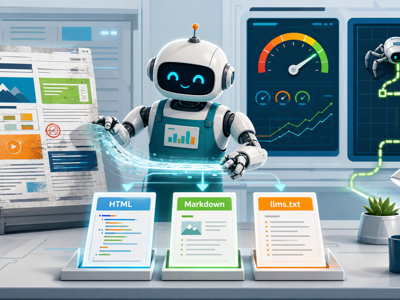
Safari MCP for AI debugging, seoClarity's markdown guide, agents skipping hard-to-parse pages, and llms.txt checks. Visibility #24: Serve Markdown to AI Bots Now Week of June 30 - July 6, 2026 | AI Search & Visibility Intelligence It was a quieter news week for big platform announcements, but the technical layer got more interesting. Apple shipped an MCP server for Safari that opens AI-based debugging for SEO and Core Web Vitals. seoClarity published a practical guide to serving markdown to...

Similarweb ties AI brand mentions to direct visits and branded search, while citation freshness keeps getting shorter. Visibility #23: AI Brand Mentions Drive Real Traffic The Visibility Report #23 - Week of June 23 - June 30, 2026 Lead item: Similarweb has data tying AI brand mentions to later direct visits and branded search. That is the strongest case so far that citations can create demand, not only awareness. Also this week: citation decay, Google spam enforcement in AI answers, schema...

Google AI Overviews are pervasive, under-discussed, and likely where most users will meet AI search first. Visibility #22: The AI Search Surface You Are Not Tracking The Visibility Report #22 - Week of June 16 - June 22, 2026 I have been saying from the podium that Google AI Overviews are already pervasive and still under-discussed. The AI search conversation keeps drifting toward ChatGPT and Perplexity because those products feel newer and more separate from the old search habit. But Google...