Visibility #18: AI Visibility Gets a Measurement Layer
The Visibility Report - Tuesday, May 26, 2026
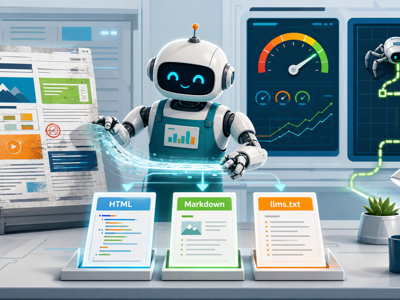
The AI visibility conversation is moving from "Can we show up?" to "Can we measure where, why, and what happens next?"
That is a better conversation. Microsoft Clarity now exposes citation and grounding-query data. Google-Agent gives agent visits a name and a verification path. Ahrefs is separating human chatbot referrals from crawler traffic and showing why the small traffic numbers can still matter.
The theme this week: AI search is becoming less mysterious, but only for teams willing to instrument it properly.
Top Story: Clarity Makes AI Citations Operational
Microsoft Clarity's Citation dashboard gives site owners a view into how their content is referenced in AI-generated answers. The dashboard tracks page citations, share of authority, AI referral traffic as a percentage of sessions, grounding queries, and cited pages.
The grounding-query layer is the useful part. It shows the queries AI systems used to retrieve your content before generating an answer. Those queries may not match the user's exact prompt, but they reveal how AI systems map your content to topics and intent.
Why it matters: this is not classic rank tracking, and it is not click-through-rate reporting. It is a measurement layer for influence inside the AI answer experience. That helps teams find pages that are already being treated as sources, spot coverage gaps, and decide which content needs clearer structure or stronger authority signals.
Sources: Microsoft Clarity Citation dashboard docs (https://learn.microsoft.com/en-us/clarity/ai-visibility/ai-citations) | Search Engine Land coverage (https://searchengineland.com/microsoft-clarity-citations-dashboard-rolls-out-477663) | SEJ on grounding queries (https://www.searchenginejournal.com/microsoft-clarity-now-shows-grounding-queries-behind-ai-citations/575279/)
Google-Agent: Agent Traffic Gets an Identity
Google-Agent is the user agent string for AI systems on Google infrastructure that browse websites on behalf of users. Search Engine Journal's writeup makes the distinction clear: this is not Googlebot indexing the web continuously. It is a user-triggered fetcher, with Project Mariner named as the first product using it.
The operational takeaway is simple: monitor logs for Google-Agent, check CDN and firewall rules, and test the forms or flows agents may need to complete. Google is also experimenting with web-bot-auth for cryptographic bot identity, which points toward a web where agent verification matters as much as crawler verification.
Why it matters: agent traffic is becoming a distinct audience. Humans, crawlers, and agents have different intent and access patterns. Websites that treat every non-human visit the same will miss useful data and may accidentally block real user-requested agent activity.
Sources: Search Engine Journal (https://www.searchenginejournal.com/google-agent-the-webs-new-visitor-just-got-an-identity/571508/) | Google crawler and fetcher documentation (https://developers.google.com/search/docs/crawling-indexing/google-common-crawlers)
AI Chatbot Traffic: Small Share, Serious Intent
Ahrefs' chatbot traffic guide separates two things that often get blurred together: AI crawler traffic and human visitors who click citations inside ChatGPT, Perplexity, Gemini, Claude, or Copilot.
The traffic share is still small. Ahrefs cites 3.5 million AI chatbot referrals across 74,752 sites in March 2026, about 0.28% of total traffic. But the quality signal is interesting: Ahrefs says AI search visitors were 0.5% of their visitors and drove 12.1% of signups, a 23x higher conversion rate than organic search.
Practical read: track AI assistant referrals separately, compare engagement and assisted conversions, and do not mistake low volume for low value. If a chatbot referral lands after the AI has already framed the decision, that visitor may be closer to confirmation than discovery.
Sources: Ahrefs: AI chatbot traffic (https://ahrefs.com/blog/ai-chatbot-traffic/)
AI Agents for SEO: Useful When They Do the Boring Work
Ahrefs also published a guide to AI agents for SEO. The strongest use cases are not magic strategy replacements. They are repeatable workflows: finding gaps, checking pages, comparing competitor coverage, prioritizing updates, and turning messy data into a clear next action.
Why it matters: the agent layer is most useful when it compresses analysis time. The strategist still needs to decide what is worth publishing, what is worth changing, and what claims are strong enough to stand behind.
Sources: Ahrefs: AI agents for SEO (https://ahrefs.com/blog/ai-agents-for-seo/)
Google's AI Optimization Guide Is Still the Baseline
We covered Google's AEO/GEO guidance heavily last week, so this is a follow-up, not the lead. The durable takeaway remains: for Google's generative AI features, the foundation is still crawlability, useful people-first content, clear structure, media, product and local details where relevant, and Search Console.
The wrong takeaway is "GEO is fake." The better one is "there is no shortcut layer that replaces source quality." Google's guidance is a baseline for Google surfaces. AI visibility across ChatGPT, Perplexity, Reddit, LinkedIn, YouTube, and third-party listicles still requires broader source-building.
Sources: Google AI optimization guide (https://developers.google.com/search/docs/fundamentals/ai-optimization-guide) | Google Search Central announcement (https://developers.google.com/search/blog/2026/05/a-new-resource-for-optimizing)
Custom Visuals Still Earn Their Keep
Search Engine Land covered a six-month test across 47 articles comparing custom infographics with stock images and no visuals. The standout finding: articles with custom infographics averaged 110% more organic traffic than the control group.
Why it matters: original visuals are not just polish. In a world where AI and humans both need clear evidence, charts, diagrams, and explainers can make a page more useful, more linkable, and easier to cite. The source does not prove an AI-citation lift, so keep that claim separate.
Sources: Search Engine Land (https://searchengineland.com/custom-visuals-organic-traffic-boost-477633)
Tool Blogs: Measurement Workflows Are Getting Built Out
Scrunch: Scrunch MCP (https://scrunch.com/blog/scrunch-mcp-talk-to-and-act-on-ai-search-data-in-natural-language) lets teams query and act on AI search data from chat interfaces, and LinkedIn citation research (https://scrunch.com/blog/linkedin-posts-robots-cant-resist-what-data-says-about-chatgpt-citations) digs into which LinkedIn posts show up in ChatGPT citations. Scrunch pages show last-updated dates of May 12 and May 6.
Profound: the branded link update (https://www.tryprofound.com/blog/chatgpt-referrals-branded-links) and Benchmarking in Agent Analytics (https://www.tryprofound.com/blog/introducing-benchmarking-in-agent-analytics) are May updates that keep Profound pointed at measurable AI referral and competitive visibility workflows.
AirOps: Prompt Discovery (https://www.airops.com/blog/announcing-prompt-discovery) and Content Publish Tracking (https://www.airops.com/blog/announcing-content-publish-tracking) connect the prompt universe to publishing actions and outcomes. AirOps does not expose article dates in page metadata, but both are current blog/product-update entries.
Peec AI / Otterly: Peec AI's Listicle Rank Effect study (https://peec.ai/blog/the-listicle-rank-effect-what-nearly-200-000-ai-responses-across-8-ai-engines-reveal-about-brand-visibility) is dated May 14, and Otterly's Google GEO guide (https://otterly.ai/blog/google-geo/) is dated May 21. Both are fresher than the older Peec MCP and URL-citation-study links.
More From This Week
Search & AI Search
- Foundation: publishers are planning for lower search traffic scenarios (https://foundationinc.co/lab/vol-292/)
- SEJ: FAQ removal and schema's AI-search value (https://www.searchenginejournal.com/serp-faq-removal-new-data-challenge-schemas-ai-search-value/574993/)
- Search Engine Land: product packs as an ecommerce visibility channel (https://searchengineland.com/google-product-packs-ecommerce-visibility-data-477592)
Tools & Practitioner Notes
- Semrush: prompt tracking (https://www.semrush.com/blog/prompt-tracking/)
- Marie Haynes: crawled, currently not indexed and preparing for agents (https://www.mariehaynes.com/crawled-currently-not-indexed-preparing-websites-for-agents-and-how-im-using-antigravity/)
- Amsive: earning a place in the AI-shaped shortlist (https://www.amsive.com/insights/seo/when-ai-shapes-the-decision-how-brands-earn-a-place-in-the-shortlist/)
- SparkToro: audience research for mid-market RevOps leaders (https://sparktoro.com/blog/audience-research-brief-how-wed-market-to-mid-market-revops-leaders/)
- Seer: GEO Olympics study (https://www.seerinteractive.com/insights/what-ai-thinks-about-your-brand-is-already-written)
What to Watch
1. Citation data moves from novelty to a standing dashboard in SEO reporting.
2. Agent logs become part of technical SEO, especially for forms, booking flows, ecommerce, and gated content.
3. AI referral traffic stays small but gets judged on intent and conversion quality, not volume alone.
4. Tool blogs are shifting from monitoring toward workflows: prompt discovery, citation analysis, content tracking, benchmarking, and integrations.
So What Do You Do About It?
Add AI visibility to the measurement stack before you add more tactics. Set up Clarity citations, segment AI assistant referrals, check agent traffic in server logs, and identify which pages are already being treated as sources.
Then improve those pages like source documents: clearer answers, stronger structure, fresher data, original visuals, and better proof. AI visibility work gets much easier when you know which machines already trust you.
---
The Visibility Report | Will Scott
This newsletter is produced collaboratively by Will Scott (https://www.linkedin.com/in/williamscott/) and Bob (https://bobtherockstaragent.com/), an AI agent. Human oversight, AI efficiency. |